
Outline for a Plan for the Establishment of a Royal Academy of Music
by Preesha Sanghrajka
Click here to see a Transcription of this document
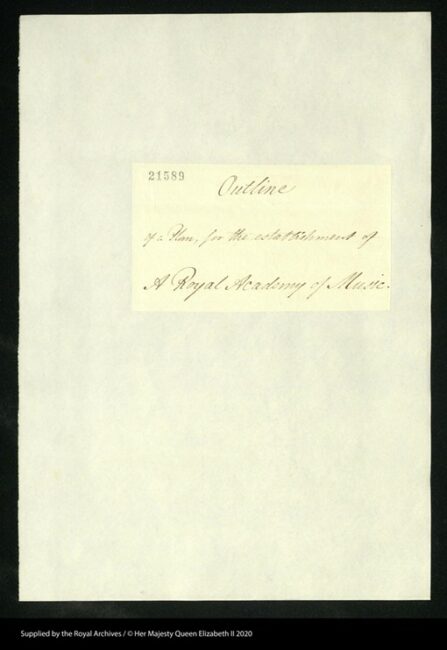
GEO/MAIN/21589
This proposal for a Royal Academy of Music, as the first national school for music, was likely written by Johann Peter Salomon in 1814. A German violinist, conductor and impresario, who was responsible for bringing Haydn to London in the 1790s, Salomon was uniquely positioned to understand both Britain’s musical potential and its deficiencies. Addressed to George IV, he requests for a formal educational institution to be established, similar to the Royal Academy of Painting, in order to raise Britain’s musical reputation to be on par with that of the rest of Europe. Salomon was one of the founding members of the Philharmonic Society, which was a group of musicians, founded in 1813, who encouraged the performance and commission of classical music in Britain. The Academy was proposed to have been supported and run by the Philharmonic Society under Royal charter, which meant that they would have been able to then shape the output of British music through new composers and performers. Though the proposal was not successful and the current Royal Academy of Music did not achieve its Royal Charter until the 1830s, this document offers a window into how cultural elites wanted to manufacture national prestige through a controlled musical education and what they believed British music should become.
In the early 19th century, despite much music being published in England, the English gained a reputation of “not [being] a musical people” [1] . While ‘Great Master’ composers, such as Austrian-born Haydn and German-born Handel became favourites of British audiences and the Royal Family, Britain’s own output of these ‘Great Masters’ was lacking. As Salomon highlights in his proposal, music played a large part in people’s lives within this time. The Church, Military and domestic spheres saw a flourishing in music, but much of this music did not garner an international audience, and thus left Britain with a reputation of being an admirer of music, instead of a creator. Creating a national school of music would thus fill this gap, with the hope that it would churn out Britain’s ‘Great Masters’. Paris’ Conservatoire National de Musique et d’Art Dramatique had opened in 1784, with subsequent secular music academies opening in Milan in 1807 and Prague in 1811 – British music was falling behind.
This mission of elevating Britain’s musical reputation was reflected in Salomon’s suggestions for curriculum. He intended the Academy to become a place for education and research, and for the institution to have a library, create a dictionary of musical terms and to regulate tempos and time signatures, and for this to be implemented in British music going forward. This would create a lasting legacy of musicology and would weave this legacy into the institution and the subsequent compositions that came from it. Salomon’s proposal for composition prizes further cements the ideas of what the Society deemed the future of British music. The focus on chamber, instrumental and secular music forms means that these compositions are especially suitable for the concert hall – a notion of large importance to the Society as they frequently organised concerts. [2] This output would have been in the hands of the Crown and the Society, with the Prince Regent choosing academicians and students, but with the recommendation of the Society, which provided both of their best interests. However, this approach means that a very specific academic space would have been created, which would have run the risk of contributing to a narrow musical canon, due to a lack of innovative ideas and a focus on chamber and orchestral works, potentially marginalising solo repertoire in favour of ensemble music. Yet, it is clear that through the educational structure and administrative logistics, Salomon envisioned this institution to create a lasting legacy of British music, supported by the Crown and the Society.
Despite its place in the Royal Archives, this proposal was not successful and the Royal Academy of Music as we know it today was founded in 1822 by John Fane, the eleventh Earl of Westmorland. There were a few attempts before Salomon’s to create a musical educational institution, such as Charles Burney’s suggestion to establish an Academy in partnership with the Founding Hospital, a children’s charity which educated and cared for abandoned and orphaned children. This proposal would have allowed these children to have been musically trained, but it was argued that “music was an art of luxury” [3], and as such these children should be educated to become “plain but essential members” of society [4]. Thus, this proposal was abandoned, and the next recorded plan in Cazalet’s The History of the Royal Academy of Music (1854), was Thomas Forbes Walmisley’s proposal on behalf of the Philharmonic Society in the 1820s, with no mention of Salomon’s 1814 proposal. Despite both being from the Society, Walmisley and Salomon’s proposals have differing logistics. Walmisley centred his curriculum around “Singing, Counterpoint, Composition, and the practice of the most useful instruments” [5], with the school catering to younger children, around the ages of 12-14. Salomon’s proposal is more aligned with a university setting, similar to that of the current Royal Academy of Music, where students were expected to have proficiency in an instrument prior to their enrolment.
Interestingly, Salomon’s proposal is not mentioned in Cazalet’s book, despite it only being written 40 years later. Salomon’s plea to the Prince Regent would not have been unplanned or written alone, and alongside the proposal there is a list of prospective Academicians in the Royal Archives, so why is there so little mention of it? Perhaps, it had something to do with Salomon’s death in 1815, which left the project with no figurehead; or a potential lack of funding or support. Either way, its place in the Royal Archives leaves more questions than answers, and we are unable to know how different British music would have been if this proposal had come to fruition.
Despite it not being successful, this document as a snapshot of musical history serves as valuable insight into early 19th century British musical ambitions. It reveals the power structures of the Crown, aristocracy and the Philharmonic Society that was capable of shaping cultural institutions and society to manufacture international musical prestige for Britain. The proposal’s emphasis on particular musical forms and its vision for lasting musicological infrastructure demonstrate not only what British music lacked, but what it was believed it should become. The proposal’s survival in the Royal Archives, despite its absence from subsequent histories, highlights how cultural institutions develop through both successes and failures, with the latter often revealing just as much about a society’s values and aspirations.
[1] Simon Fleming, ‘The Land without Music: Some Post-1800 Perceptions of 18th-Century British Music’, The Musical Times 159, no. 1943 (2018): 95
[2] “A Brief RPS History,” Royal Philharmonic Society, n.d.,
[3]Cazalet, William Wahab. “Chapter I.” In The History of the Royal Academy of Music: Compiled from Authentic Sources, 4.
[4] Cazalet, The History of the Royal Academy, 5.
[5] Cazalet, The History of the Royal Academy, 11.